

Can AI Church Translation Really Achieve 99% Accuracy? What We Know After Years of Church Interpreting
 9 min read
If you've been researching church translation software, you've probably seen it: bold claims of 99% translation accuracy plastered across a homepage. It sounds reassuring. It sounds like exactly what you need before you trust a piece of technology with your Sunday service.
Here’s the problem, though: such numbers are influencing churches' purchasing decisions and, in turn, their ability to serve real people with God’s Word every Sunday. We believe there should always be a clear difference between communicating confidence in your product vs making absolute claims that don’t stand up to scrutiny.
So in this post, we want to explain our thinking behind this, because we believe you deserve to understand both what accuracy means in terms of church translation and what it takes to get it right.
So...can AI sermon translation really achieve 99% accuracy? Let's get into it.
What does "99% accuracy" actually mean?
On the surface, 99% translation accuracy sounds almost perfect. But ask yourself: 99% of what, exactly? Under what conditions? Measured how? To quote the classic 80’s movie The Princess Bride, “You keep using that word. I do not think it means what you think it means.”
A 99% word-accuracy rate on a clean, studio-recorded audio file, with a native English speaker speaking at a steady, measured pace, is one thing. It’s entirely another thing to claim 99% accuracy on a live Sunday service with a multitude of background sounds, a pastor who speaks quickly, or moves their handheld mic away from their mouth as they gesture passionately, and a sermon full of names like Melchizedek, Habakkuk, and Jehoshaphat.
At OneAccord, we claim that 100% transcription (not translation) accuracy can be achieved, not by AI alone, but by using our optional Moderation function, which allows you to make any changes to the transcript yourself before it hits our translation algorithm. We’ll look at this in more detail later in the article.
Any company claiming a flat accuracy figure for live sermon translation, without specifics on how they measured or achieved that figure, is giving you a marketing number, not a technical one.
We’re church interpreters. We know what real-world accuracy looks like - and it’s never a single percentage.
Why live church translation is genuinely hard
Before we explain how we approach this, it's worth appreciating what AI is actually being asked to do in a live service.
It needs to transcribe speech in real time, often with a microphone picking up and amplifying any number of background sounds and noises, both obvious and subtle – “amens” and “hallelujahs”, musicians playing softly, babies crying, chairs shuffling, etc. It needs to recognise names from the Old Testament, theological terms that don't necessarily translate word-for-word between languages, and the specific idioms a particular pastor has used for thirty years. It needs to do all of this live, in a fraction of a second, and then translate it accurately into the target language – capturing not just the words, but the meaning.
Off-the-shelf AI can do a surprisingly decent job of this. But "decent" should not be the standard for God's house.
Off-the-shelf AI vs. what we've built
Many AI translation tools on the market today are, at their core, general-purpose AI engines. Even those that market themselves as church-specific are often the same off-the-shelf technology with biblical keywords added on top.
Now, don’t misunderstand us; they are powerful, and the underlying technology is genuinely impressive. However, it’s worth asking, do the people who built them know what it’s like to sit in interpreting booths, headphones on, no AC, trying their best to keep up with a pastor in full flow – all so that someone can hear the teaching of God’s Word in their heart language, maybe even for the first time?
We do.
Our team includes real church interpreters with years of hands-on experience providing live simultaneous interpretation in their local churches. That experience is baked into how we've built and trained OneAccord.
We use custom AI models trained specifically for a church context. That means we go far deeper than a glossary of biblical terms. Our models are informed by the kinds of language that appear in sermons – scriptural references, biblical names and places, theological concepts, and the pastoral vocabulary that shows up week after week in churches. It's the difference between an AI that transcribes “every hedge bowed and nice clothes” and one that accurately transcribes “every head bowed and eyes closed”.
Why audio quality is the first place accuracy is won or lost
Here's something that doesn't get talked about enough in conversations about AI church translation software: the AI is only as good as the audio you give it.
This isn't unique to AI; after all, a human interpreter can also only work with what they can hear. Even the most skilled interpreter would struggle with a muffled pastor’s microphone, a noisy room, or PA system feedback just as surely as any AI translation platform would.
That’s why a clear, well-balanced audio feed from your church's sound desk will produce dramatically better results than using the inbuilt mic on your laptop or cell phone that may also pick up the hum of your PA system or AC unit; any nearby whispered conversations; or echoes bouncing off the sanctuary walls…
That’s even before you get to more obvious audio issues like the distance of the mic from the person speaking; how it handles your speaker’s natural dynamics – i.e., does it distort when they get loud? – not to mention the overall quality of the captured audio. All these issues chip away at accuracy before the AI has even begun its work.
This is why dedicated audio support isn't an optional extra at OneAccord. It's central to what we do. We have a sound technician on staff, and we provide built-in tools that let you monitor your audio feed quality in real time during a session. But we go further than that, with our team carrying out weekly audio quality checks and proactively getting in touch if we notice a drop in quality.
Why we have a QA team – and why that matters
Accuracy isn't a set-and-forget feature. It requires ongoing attention.
We carry out regular Quality Assurance checks on our sermon translations. Our team listens, evaluates, identifies patterns where the AI is underperforming, and feeds that learning back into improving the models. If your church is consistently using certain phrases, names, or terminology that the AI is mishearing, we want to know about it and fix it.
No automated church translation software does this for you. It takes human expertise, applied consistently over time. It's an approach that has earned the trust of over 200 churches, and one we apply consistently to every congregation on our platform.
The moderation feature: not extra work, but extra confidence
One of the features we're most proud of is our moderation feature, and we’d love to talk a bit about it here.
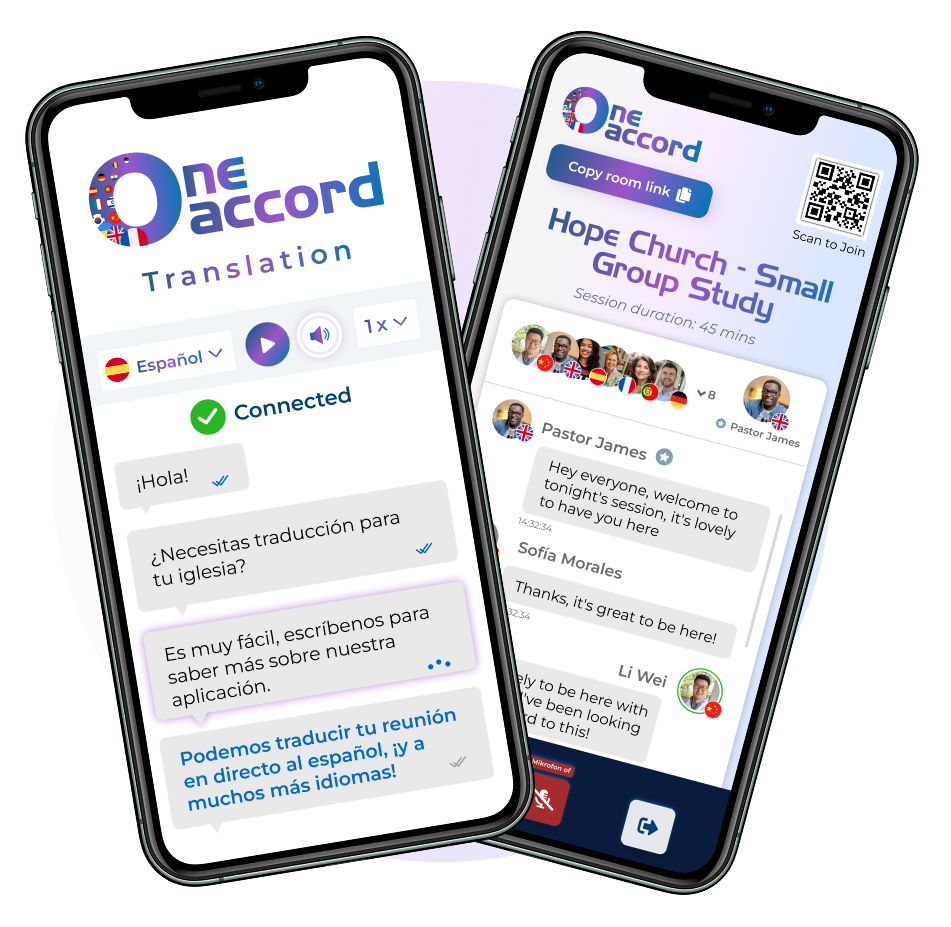
Moderation is an optional tool that gives you, the translation host, a brief window to review each line of transcription before it's finalised, translated, and sent out to your congregation. If everything looks right – and most of the time it will – you take no action and move on. If you spot something that needs a quick correction, you can fix it in seconds.
It's the same instinct that leads a good interpreter to pause for half a beat when they want to make sure they've got something exactly right. It's not hesitation. It's care.
Imagine a chef’s meal with the little extra herb garnish or sprinkle of cheese on top of the dish - you know the meal will taste great without it, but it adds a little extra sense of refinement.
In the same way, moderation isn't a requirement to get great results with OneAccord. Our AI is trained to perform well from your very first session. But for churches that want that extra layer of human oversight – particularly when a guest speaker has an unfamiliar accent or word pronunciation, or when the sermon includes terms unique to your community that the AI hasn't encountered before – moderation puts control in your hands.
It's the human touch, made available at the moment it's most useful.
So what should you ask a translation provider?
Rather than taking a translation accuracy claim at face value, here are the questions worth asking:
Who built this, and what do they know about church interpretation? Software built by developers is not the same as software built by people who've sat in the interpreter's booth.
How was that accuracy figure measured? On what kind of audio? Under what conditions? With what kind of content? If the answer is vague, the number is vague.
What happens when the audio isn't perfect? Every church has imperfect audio sometimes. What support is available when that affects the translation?
What does the ongoing quality process look like? Is the translation provider regularly reviewing their translation output and improving accuracy over time, or is the AI left to its own devices?
A question worth sitting with
We started OneAccord because we ourselves have lived the experience of being in a church where we couldn't understand a word and felt the profound gift of a faithful interpreter who gave us access to the message.
That's what's at stake every Sunday for the non-English speakers in your congregation. Not a customer-experience metric. Not a user-satisfaction score. The ability to hear and understand the word of God in their own language. After all, that’s what inspired us to become church interpreters in the first place.
So here is the question we'd gently put to every church leader comparing translation tools:
Do you want your AI sermon translation handled by AI alone, or by AI guided by professional church interpreters who've dedicated years to getting this right?
We don’t claim 99% translation accuracy, because church translation and everything it involves requires a lot more nuance than that. Instead, we claim something harder to measure and more important to us: that we care about the quality of what reaches your congregation’s ears; that we know what it takes to get a good translation, and that we will use that knowledge to support your church every step of the way.
That's what makes OneAccord different.
Want to experience it for yourself? Get in touch to request a free trial — we'll have you set up and translating before your next service.